
May 1st, 2024 | 4 min read
ADC Tracks General Manager, Kevin O'Grady, Talks About Innovation & More.
Reprinted from "Lighting & Sound America" (LSA) magazine interview.
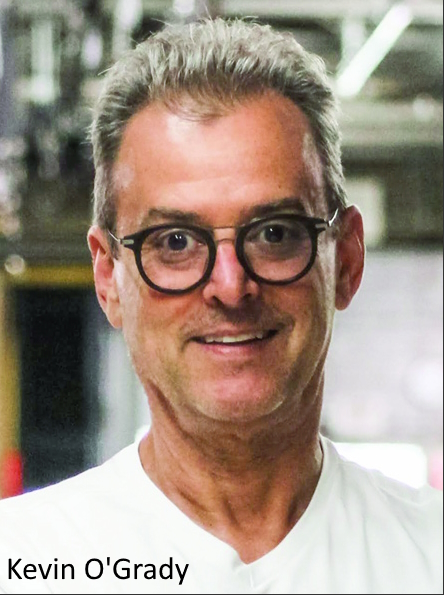
LSA: How did you get started in the industry?
Kevin O’Grady: I sang as a young child; then my voice changed, and I went in an afternoon from being a tenor to a third baritone with a very crackly voice. Choral directors were no longer interested in me! In high school, I was interested in theatre. I got on the stage crew; I started building scenery, and that never stopped. After college, I was in Cincinnati, working for sound and lighting companies and stage-managing at a club called Bogart’s. I went to Paramount Productions, building shows for Paramount theme parks, and then to Adirondack Scenic and, later, Tait Towers, ACASS Systems, and Automatic Devices/Rose Brand. And here we are today!
LSA: What did you do at Tait Towers?
Kevin: I was operations manager there for 23 years. It was Michael [Tait], Winky [James Fairorth], and Karen answering the phone when I started. That was the whole front office. We were at the old Clair Brothers/box factory on Water Street, next door to Michael’s house. When I left, a year after Michael left, we were in a neighborhood of 200 people and five, maybe six locations, and it was just starting to get crazy. That was probably the most influential period of my life. In a world that can be a little overwhelming at times, it gave me benchmarks: Whatever you are up against, it can’t be as bad as doing a Rolling Stones stadium show in ten weeks! (Laughs)
LSA: How did you join ADC?
Kevin: I’ve known George Jacobstein [Rose Brand’s owner] for well over 40 years. Probably approaching 50. I was at LDI eight or nine years ago. I was talking to Josh [Jacobstein, Rose Brand’s president] at the show and he asked, “How come you never come to work for me?” Here we are.
LSA: How do you think ADC has evolved since Rose Brand acquired it?
Kevin: I think the perception of ADC is of a tried-and-true solution to pretty common challenges. We’ve never really been thought of as innovators. My background has been a constantly evolving landscape of technology where you’re bringing in new protocols, new machines, and new devices. Now, at ADC, our new Axis1 control platform is pretty revolutionary. We’ve gone from little push-button controllers to systems that can handle many axes and take positioning input from most show control and lighting consoles. Our ConTour hoists run on the Axis1 system. It’s SIL 3-compliant, meaning you can use it safely, and it works over virtual wire. It does everything over standard CAT6 connections, and you can daisy-chain devices. It’s got the best of automation and lighting control, plus a lightweight infrastructure requirement, so implementations that were expensive are now within the budgetary reach of anyone who can afford an Art-Net lighting console and a network switch.
LSA: Are there other ADC products currently being worked on?
Kevin: We’re about to release an updated line of curtain machines, several variations of our ConTour point hoist, an I/O module, the PinPoint chain hoist, and a “do-it-yourself kit.” It’s a simple network drive and a motor that can attach to anything you want. If you’re building your own stuff and you need a two-horsepower AC motor to run it, we can give you the drive and the motor; you can attach that to your equipment and control it from the Axis1 platform, which means you can use a lighting console. The other beauty is everything’s remotely accessible. If you connect to Wi-Fi, we can see you and remotely control your Axis1 controller to help with drive parameters or writing a cue, for example.
LSA: How do you look back on your career so far?
Kevin: Man, there’s been so many things that could have gone different ways. I consider myself incredibly fortunate. I had a lot of work as a very young freelancer and ended up getting stable employment when I was barely 20 years old. When I went to Tait, I was probably 24 or 25 years old, and I made a livelihood there. There’s no better training in the world. And then, coming out from under Michael’s tutelage for a quarter of a century, to take that out into the world on my own…I’ve been very fortunate to use my experience, in a way that I think helps the industry and feeds my family.
Recent Posts
One might think that a fabric company has little to do with lighting. After all, while scenery and lighting design are inexorably linked, how important can fabric be to either? Yet the choices a designer makes in fabric, as with all the other elements, will directly affect the final look of the production.
As high grade recording equipment becomes more affordable and non-linear editing software becomes more robust, even grade school children can now post high quality video content to YouTube on a regular basis.
You don't have to know every detail of your Stage Curtain to get a reliable budget estimate. This article covers the most important factors
Featured Posts
Scenic designers use Netting and Gauze fabrics in combination with other scenery and lighting to create visual illusions and spatial depth. The transparency of netting and the translucency of gauze make these fabrics particularly well suited for these effects. The following describes the characteristics of various nettings and gauzes and how you might use them to best effect.
Design, Specifications & Build Custom Services

We produce more stage & event curtains and backdrops than any other provider. Get a quote.

Email or call us at 800-223-1624 with a brief description of your project.

Use our Fabric Finder to easily search for any theatrical or event fabric