
April 3rd, 2014 | 2 min read
Kaos helps depict steamy Mississippi Delta and character dynamic for "Cat on a Hot Tin Roof"
Scenic Designer Wanted To Create Hot & Humid Atmosphere In Theatre In Alaska

Post: The following is an edited version of our interview with Akiko Nishijima Rotch, Set Designer, “Cat on a Hot Tin Roof” playing at both the Perseverance Theatre in Juneau and the Alaska Center for the Performing Arts in Anchorage.
Rose Brand: What was your overall design objective for the production?
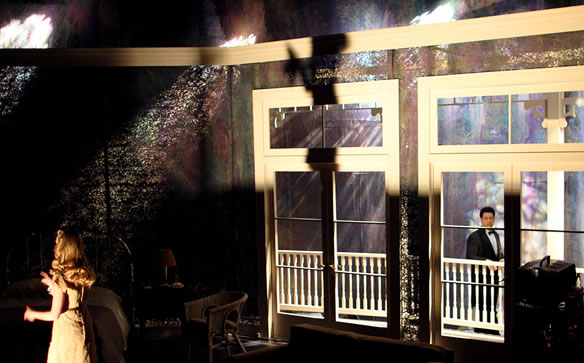
Rotch: The play “Cat on a Hot Tin Roof” By Tennessee Williams takes place in the Mississippi Delta area, which has a very hot & sticky environment. The hot weather affects the characters of this play a lot. The biggest challenge I faced as the set designer was how to create a hot & humid atmosphere in a theatre in Alaska.
When I researched the environment of Mississippi, I saw a lot of images of Spanish moss. I felt that those images quickly communicated the feeling of the South, and so Spanish moss became my design motif.
Another important point of the set design was to communicate that characters have no privacy in their home. For example, Mae is always trying to eavesdrop on what Maggie and Brick are saying. Since this is an important aspect of the play, I wanted the set to visually express it.
Rose Brand: How did you achieve your design objectives?
Rotch: I started to look for a material that had both translucency (a metaphor for no privacy) and an organic shape (a metaphor for the Spanish moss). Scrim and Gauze did not have enough of an organic shape for me. Then I discovered the samples of “Kaos” material among the Rose Brand samples I’ve been receiving since I graduated from NYU in 2007.
Kaos was the exact texture I was looking for. The gaps in the material are uneven and Kaos is also paintable. The uneven gaps allowed us to express the organic shape of Spanish moss. The ease of painting allowed us to create the depth of colors we needed to complete the illusion of the moss.
We used the mossy painted, black, Kaos Medium material to represent the walls of the house in an unrealistic way. As I mentioned before, eavesdropping (and peeping) were important factors to communicate. Being able to see and hear through the walls gave the audience the sense that there was zero privacy in this space.
Rose Brand: How else might you use Kaos for future design efforts?
Rotch: A scrim effect with an organic shaped material is pretty hard to find, so I will experiment with it when I need the texture. I am also curious about Kaos Heavy next time. I would love to see the difference between Medium, which I used, and Heavy. I strongly recommend “Kaos” to create layers of magical space.

Recent Posts
One might think that a fabric company has little to do with lighting. After all, while scenery and lighting design are inexorably linked, how important can fabric be to either? Yet the choices a designer makes in fabric, as with all the other elements, will directly affect the final look of the production.
As high grade recording equipment becomes more affordable and non-linear editing software becomes more robust, even grade school children can now post high quality video content to YouTube on a regular basis.
You don't have to know every detail of your Stage Curtain to get a reliable budget estimate. This article covers the most important factors
Featured Posts
Scenic designers use Netting and Gauze fabrics in combination with other scenery and lighting to create visual illusions and spatial depth. The transparency of netting and the translucency of gauze make these fabrics particularly well suited for these effects. The following describes the characteristics of various nettings and gauzes and how you might use them to best effect.
Design, Specifications & Build Custom Services

We produce more stage & event curtains and backdrops than any other provider. Get a quote.

Email or call us at 800-223-1624 with a brief description of your project.

Use our Fabric Finder to easily search for any theatrical or event fabric